
Caldecott Medalist, bestselling author puts STEM learning at children’s fingertips with a new “how things work” book
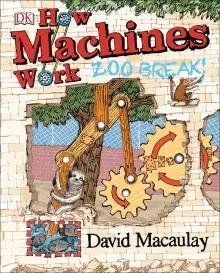
How Machines Work: Zoo Break!
by David Macaulay
“Expertly blending comedy with a substantive look at physics and mechanics.”
—Publishers Weekly STARRED REVIEW
“With much use of flaps, pop-ups, and inset booklets, the author expands on the comical plotline with glimpses of construction machinery, hydraulics, and several types of levers in action.”
—Kirkus STARRED REVIEW
“Youngsters will be eager to get their hands on this simply amazing book.”
—Booklist STARRED REVIEW
An interactive book that shows how simple machines work. David Macaulay’s How Machines Work: Zoo Break! uses pop-ups and award-winning illustrations to demonstrate the technology of the six simple machines. Follow the mad antics of Sloth and his side-kick Sengi as they try to break out of their zoo with the help of levers, pulleys, screws, inclined planes, wedges, and wheels. Their efforts are brought to life through pop-up, pull-out, lift-up fun, meaning you can explore mechanical advantage through interactive science. Packed with engaging, hands-on activities, David Macaulay’s How Machines Work: Zoo Break! will gear kids up for scientific greatness!
From the master of using art to make the complex more accessible—from the human body to architecture and engineering—comes a new book that helps young readers delight in the inner workings of ordinary things. This time, David Macaulay, bestselling author of The Way Things Work, The Way We Work and Castle, who The New York Times says “sees the world with a writer’s grace, but with an engineer’s clarity,” teaches children how and why everyday machines work.
His new book How Machines Work: Zoo Break! features pop-up models, interactive elements, and beautiful illustrations to demonstrate the technology of six simple machines: the wedge, wheel and axle, lever, inclined plane, screw and pulley.
The story follows Sloth and Sengi, two zoo animals who long to be free, as they put these machines to use in a series of ingenious escape attempts. Paper engineering components such as a lever-based seesaw are cleverly integrated into the hilarious story, putting learning at the child’s fingertips as they explore the history, science and uses of each machine.
While most of his children’s books appeal to grades 5 and up, How Machines Work is Macaulay’s first book to extend to a younger set of readers, ages 7 to 10. The hands-on activities demonstrate mechanical advantage through interactive science in a way that has never before been done, making the book a prime resource for STEM curriculum and gearing kids up for scientific greatness.
About the Author
David Macaulay is the author of 28 books, including the award-winning, international bestseller
The Way Things Work. This brilliant and highly-accessible guide to the workings of machines was dubbed “a superb achievement” by The New York Times and became a NYT bestseller. His stories and illustrations are renowned for their humor, detail and ability to explain complex ideas with simple genius. His books have sold more than three million copies in the U.S., and have been translated into more than a dozen languages. His many awards include the Caldecott Medal and Honor Awards, the
Boston Globe–Horn Book Award, the Christopher Award and The Washington Post–Children’s Book Guild Nonfiction Award. In 2006 he was awarded a prestigious MacArthur Fellowship.  He lives with his family in Vermont.
A Conversation with David Macaulay
You’ve written nonfiction books on quite a variety of interesting topics. How did you come to simple machines?
DK asked me to join them on a project that would extend some of the ideas from The Way
Things Work, but for a younger audience. One of my favorite things is making the complex more accessible to readers of all ages, so how could I say no?
Would it be fair to say that sloths are underused characters in literature? How did you settle on Sloth as your protagonist?
I think sloths actually do appear throughout literature, just not in their animal form. Just look up “lazy characters in literature” online. The word “underused” is in their job description. I suggested a sengi because they belong to the same extended family as elephants and by association mammoths. Mammoths belong to The Way Things Work, so sengi was a nice compromise. This speedy little critter needed a steady and unspeedy partner, an opposite of sorts, and sloth applied for the job. Finally, it just seemed easier, sloth-like almost, to let their animal names serve as their real names.
Who do you see as the audience for this book? Do you imagine this fitting in with a school curriculum?
This one is for everybody, but it certainly does make that extra effort to reach the younger end of the scale. As for schools, I hope teachers will find the book engaging and useful enough to want to share it with their students.
You write about everyday objects in a deeply curious, intelligent, and humorous way. Where do you think this fascination with the everyday comes from?
My fascination with the ordinary comes from having been allowed first as a kid to play and take full advantage of my pre-TV, unencumbered English childhood, and second having been encouraged as a grown-up by projects like this one to keep playing. The good things in life, the things we often take for granted or don’t notice at all, are there for the viewing. We just have to learn to stop and look and question as often as possible. The rest will take care of itself.
Disclaimer: In exchange for this post, PR by the Book sent me a copy of How Machines Work: Zoo Break! for my family to enjoy.
Tagged With: Book review, Book, PR By the Book, Science, STEM, Technology
Originally published by Sarah Freymoyer and the Philly Burb Moms team on November 30, 2015.