
The Basics of Breast Health at Every Age
This healthy post was provided by Penn Medicine Chester County Hospital. Visit us online to learn more about Breast Health.
—
If you’re like most moms, I’m sure you’ll agree that there isn’t a second to worry about yourself until you’ve taken care of your family. Putting ourselves last is something we all do, but it’s not too late to make some small changes. We’re encouraging all moms to take time every day to monitor their breast health.
In this post, we’re sharing the simple steps you can work into your everyday routine to minimize your risk of breast cancer. You hear a lot about breast health, but what are the main things you need to know?
Every woman should understand her risk, adopt healthy lifestyle changes and perform the ABC’s of early detection. Use this information to educate not only yourself, but also your mother, sisters, or daughters about the importance of breast health.
Understanding Your Risk
The most significant risk factors for developing breast cancer are being a woman and getting older, two things we cannot control. One in eight women will develop breast cancer over her lifetime.
Here is how the risk looks broken down by age:
- Women in their 30s…1 in 233
- Women in their 40s…1 in 69
- Women in their 50s…1 in 38
- Women in their 60s…1 in 27
Other uncontrollable risk factors include:
- Genetic risk factors
- Older age of giving birth or never having children
- Late menopause
- Family history of breast cancer
- Treatment with radiation to the chest
- Earlier abnormal breast biopsy
- Race
Healthy Lifestyle Changes
The best thing you can do to minimize your risk is to look at your current lifestyle and see how you can tweak it to fit these guidelines – the best defense is an early offense.
- Maintain a healthy diet…low fat/increased folic acid
- Alcohol consumption…less than one drink per day
- Exercise regularly…30 minutes at least 5 days per week
- Maintain a healthy weight…body mass index (BMI) less than 25
- Know your family (and your own) health history
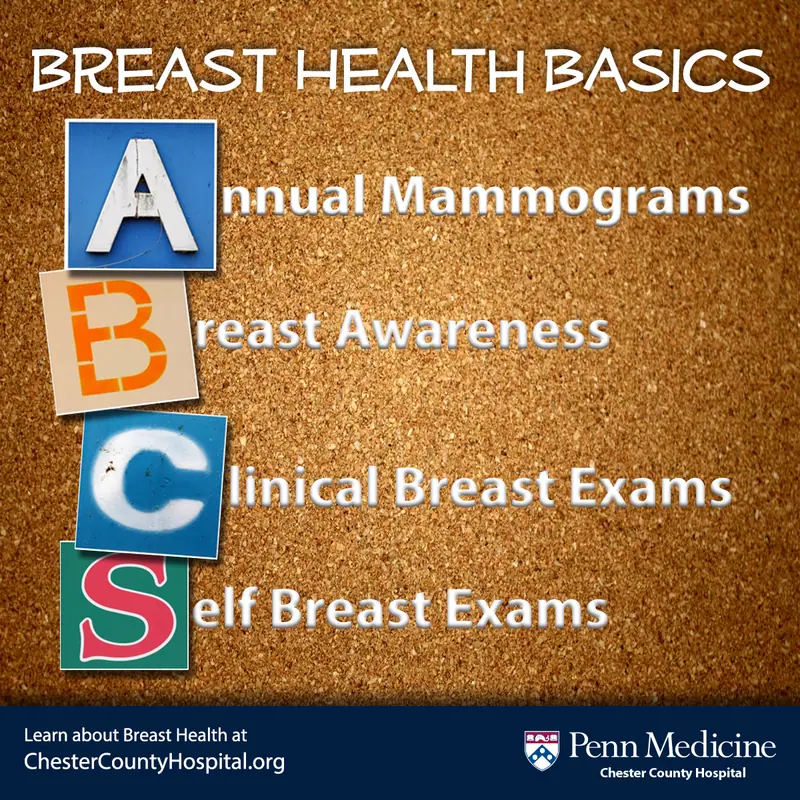
ABC’s of Early Detection
Early detection is still the best defense against breast cancer – make these practices part of your routine.
Annual Mammograms
- Start at age 40 unless you have a family history of a first-degree relative
- Mammograms can detect about 85% of all breast cancers
Breast Awareness
- Report any noted changes to your healthcare provider right away
- Normal nodularity vs. unusual changes (keep a record of your normal pattern for your breasts)
Clinical Breast Exams
- Every 3 years while in your 20s-30s
- Every year over 40 years of age
Self-Breast Exams
- Perform monthly and develop a routine
- Perform lying down and standing in front of a mirror
- Report any changes to your healthcare provider right away
Cancer Genetics Counseling and Testing
It is not uncommon to find a family history of multiple cancers afflicting both men and women in patients diagnosed with breast and/or ovarian cancer. It is estimated that approximately 5-10% of women that develop breast cancer and approximately 10% of women that develop ovarian cancer have inherited an alteration, or mutation, in one of their genes that predisposes to these cancers. The most common genes that predispose to breast and ovarian cancer are the BRCA 1 and BRCA 2 genes.
Kim McGreevy, MS, CGC is a certified genetic counselor within the Women’s Specialty Center of The Chester County Hospital and Health System. Individuals concerned about their personal and/or family history of cancer may benefit from cancer genetic counseling. The following are indications for cancer genetic counseling:
- Individuals diagnosed with cancer at an early age (younger than 50)
- Women who have been diagnosed with ovarian cancer at any age
- Individuals with two or more close relatives on the same side of the family with the same or related types of cancer (for instance breast and ovarian cancer or colon and uterine cancer)
- Individuals who have had more than one primary type of cancer (bilateral breast cancer or women with both breast and ovarian cancer)
- Individuals who have a family member who has been found to carry a mutation in a cancer predisposition gene
- Individuals of ethnicities that are known to have a higher risk to carry mutations in the BRCA 1 and BRCA 2 genes (for example Ashkenazi Jewish)
If you are interested in scheduling an appointment with a genetic counselor to discuss your personal and/or family history of cancer and the option of genetic testing, you can contact Kim McGreevy, MS, CGC at 610.732.6739.
—

Tagged With: Breast health, The Chester County Hospital, Women's health
Originally published by Sarah Freymoyer and the Philly Burb Moms team on September 18, 2013.